

DataSync · 01
Reducing Activation Friction in Complex B2B Product Systems
A confidence-driven redesign informed by recurring usability friction in enterprise platforms
- B2B SaaS
- Enterprise UX
- Conversion Optimization
The framework was designed conceptually. Impact metrics are projected using comparative onboarding benchmarks in configuration-heavy SaaS platforms.
When Structural Complexity Surfaces Too Early
In enterprise product configuration workflows, structural complexity often surfaces before users build confidence, increasing drop-off before first publish. This case explores how restructuring the mapping phase can reduce activation leakage through progressive completion and real-time publish readiness.
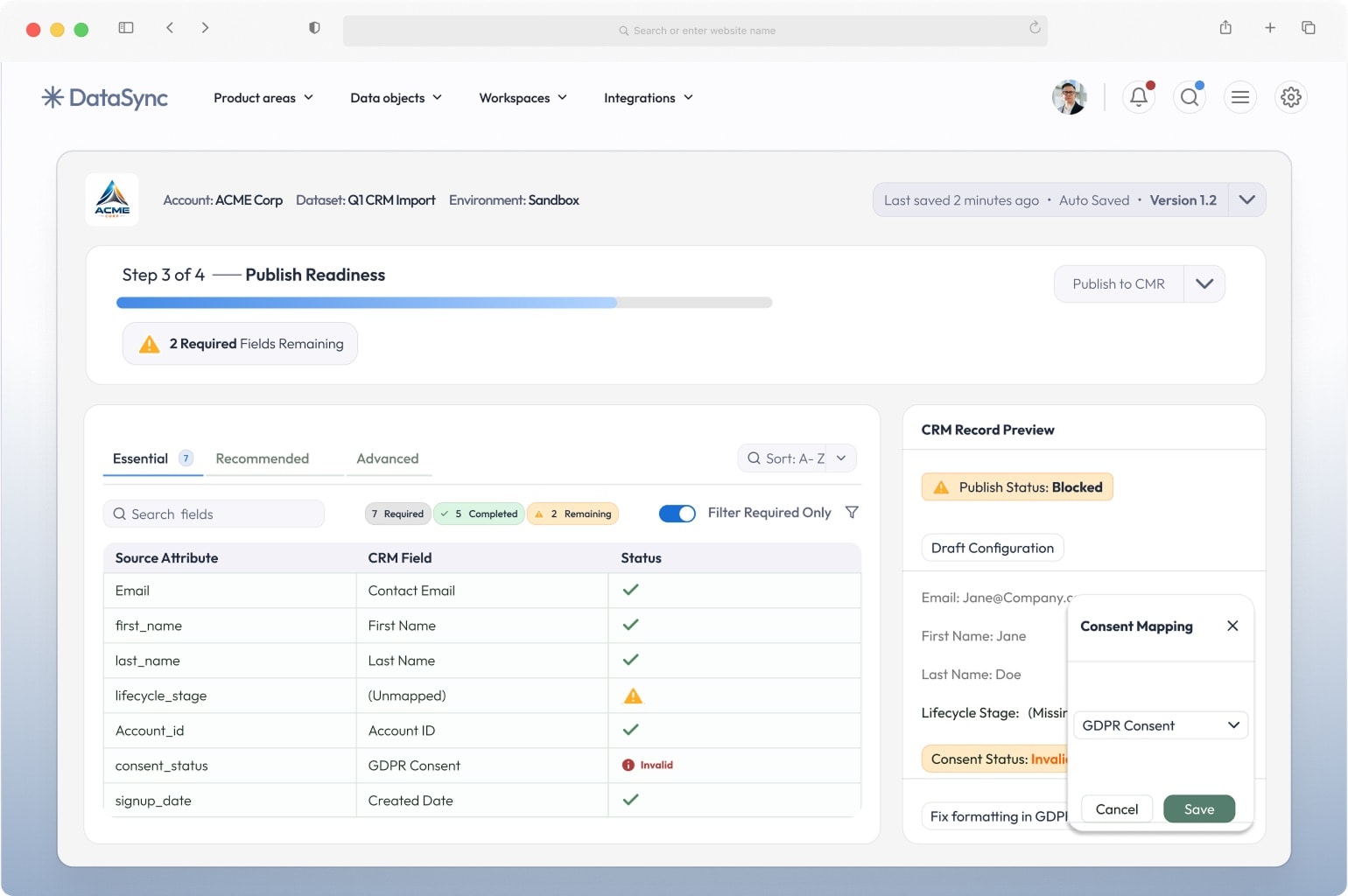
When Validation Comes Too Late
Onboarding time is lost when configuration errors aren’t surfaced until the final publish step.
In complex enterprise configuration workflows, users are often exposed to full system depth before understanding what constitutes successful completion. Required fields, validation rules, and publish criteria are distributed across the interface, making it difficult to anticipate readiness until submission. This sequencing increases cognitive load during onboarding and contributes to activation drop-off before first publish.
Where Configuration Friction Accumulates
Undefined Completion Criteria
Users cannot clearly identify what constitutes “publish readiness,” forcing them to operate without confidence.
Delayed Validation Feedback
Critical errors are often surfaced only at submission, increasing rework and onboarding fatigue.
High Upfront Decision Density
Schema definition and attribute mapping require multiple high-impact decisions before users understand downstream consequences.
Invisible Activation Progress
The system does not communicate how close users are to completing their first successful publish.
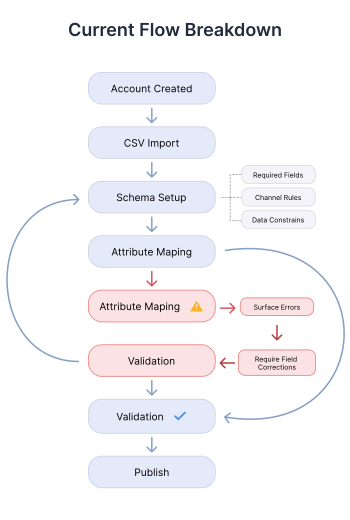
Methodology & Signal Analysis
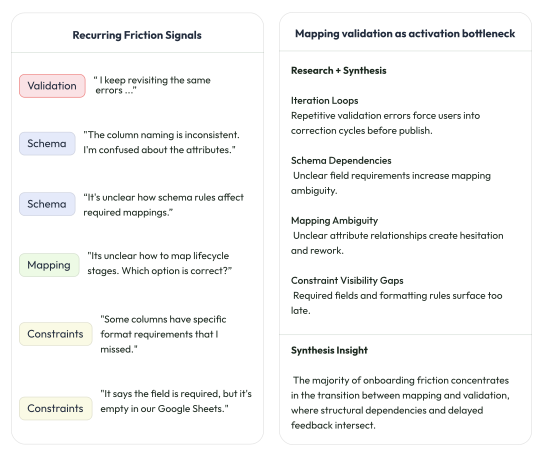
Rather than relying on isolated anecdotes, the problem was diagnosed through recurring usability friction patterns across enterprise configuration systems, with a focus on structural breakdowns in activation flows.
- Analysis of recurring usability friction patterns in enterprise PIM reviews
- Category-level evaluation of onboarding funnels in configuration-heavy B2B SaaS platforms
- Comparative study of validation sequencing across CRM and data-integration systems
Newly Onboarded Product Information Manager
Responsible for configuring and validating product data within a complex PIM environment. Often inherits legacy datasets and is accountable for downstream channel accuracy and operational continuity.
Composite profile
Responsibilities
- Owns initial data import and schema alignment
- Ensures channel-specific data integrity
- Validates configuration before first publish
Pressures
- Time-to-publish impacts go-to-market timelines
- Configuration errors cascade across marketplaces
- Early friction undermines confidence in system reliability
Success Definition
- First publish completed without critical validation errors
- Clear visibility into readiness before go-live
- Confidence to scale product rollout
The Bottleneck, Stated
The mapping–validation transition is the primary activation bottleneck.
Restructuring the workflow to reduce configuration rework and accelerate readiness.
This will increase First-Time Publish Activation
50%65%
What would be measured
System Constraints & Baseline Conditions
Before proposing structural changes, it’s essential to understand the system conditions shaping the onboarding experience. The following constraints define the operational environment within which activation occurs.
Data Reality
- Large CSV imports (often 500–5,000+ rows)
- Inherited legacy schemas with inconsistent naming conventions
- Channel-specific attribute requirements
- Interdependent fields (e.g., lifecycle stage, consent status, unique IDs)
Platform Constraints
- Validation occurs after mapping rather than progressively
- Errors are surfaced in bulk rather than contextually
- Publish is blocked by any critical validation issue
- Limited visibility into readiness prior to publish attempt
Behavioral Conditions
- Users prioritize speed during initial setup
- Schema dependencies are not immediately obvious
- Error repetition reduces confidence in system readiness
- Users expect visibility into publish readiness before final submission
Translating User Friction into Structural Signals
Public reviews often describe configuration workflows using frustration-driven language. To design structural improvements, these surface complaints must be translated into system-level signals that inform sequencing and validation logic.
Raw User Language
- “Steep learning curve.”
- “Poor usability.”
- “Complex to navigate.”
- “Too many required fields.”
- “Errors appear at the end.”
Structural Interpretation
- High cognitive load caused by simultaneous exposure to schema logic and mapping requirements.
- Lack of progressive validation and unclear publish-readiness criteria.
- High decision density without staged disclosure of essential vs. advanced fields.
- Inadequate prioritization between critical activation attributes and secondary configuration options.
- Delayed validation timing within the publish gate rather than contextual feedback during mapping.
Designing for Progressive Activation
In response to the mapping–validation bottleneck, the solution focuses on restructuring configuration around progressive completion, staged complexity, and continuous publish-readiness feedback.
Essential Mapping Mode
Progressive staging of required attributes to reduce initial cognitive load.
Real-Time Publish Readiness Score
Continuous visibility into activation progress and blocking conditions.
Inline Validation Feedback
Contextual error surfacing during mapping rather than at submission.
Channel Preview Before Publish
Live preview of how mapped data renders across channels prior to final submission.
Progressive Expansion
Controlled exposure of additional configuration layers after initial publish readiness.

Together, these structural adjustments shift onboarding from a system-first configuration process to a confidence-driven activation flow.
Wave goodbye toLate-stage validation surprisesHidden activation criteriaEndless correction loopsUpfront schema overloadUnclear publish readinessConfiguration guessworkReactive error handling
Project Constraints & Assumptions
What data was available for this redesign?
This project was based on publicly documented usability patterns in enterprise configuration systems. No proprietary analytics or internal product data were used.
Was this implemented in a live product?
The framework was designed conceptually. Impact metrics are projected using comparative onboarding benchmarks in configuration-heavy SaaS platforms.
What scope was intentionally excluded?
The redesign focused solely on first-time activation and publish readiness. Post-publish workflows, long-term feature adoption, and system integrations were outside the defined scope.
What assumptions informed the solution?
Assumptions were grounded in recurring usability friction reported across PIM, CRM, and integration-heavy SaaS platforms.
How would this be validated in a real product environment?
If implemented, validation would include A/B testing tiered mapping against flat configuration, tracking publish completion rates, validation loop reduction, and onboarding support ticket volume.
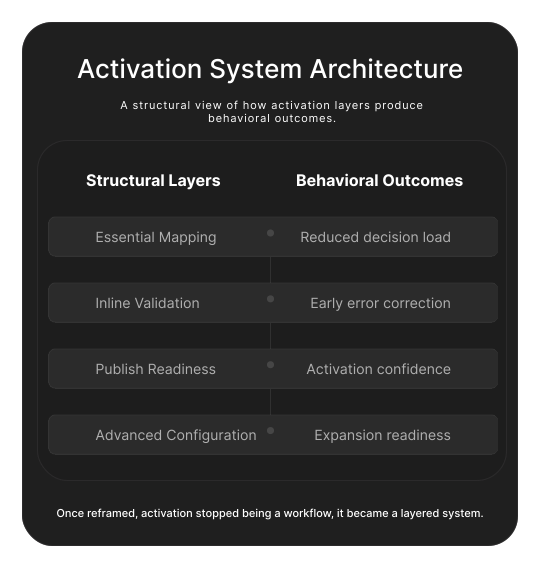
Structural Evolution of the Activation Model
Early explorations focused on visual simplification within a flat mapping structure. While interface clarity improved, the underlying decision density remained unchanged. The breakthrough came from restructuring the workflow around staged activation rather than reducing surface complexity.
Key Structural Outcomes
Decision Density Reduced
Fields exposed during initial setup ↓ 60%
Validation Iteration Loops
Correction cycles reduced through inline feedback
Activation Clarity
Readiness criteria visible before publish
Publish Readiness Transparency
Clear visibility into blocking conditions
Projected Activation Impact
By restructuring the mapping–validation workflow around progressive completion and real-time readiness, the redesigned framework directly impacts activation performance, operational efficiency, and long-term platform retention.
+15% First-Time Publish
Reduced drop-off during initial configuration
Projected Outcome↓ 30% Validation Loop Time
Inline validation reduces repetitive correction cycles
Workflow Benchmark EstimateThe activation model restructures configuration from full-schema exposure to staged completion. Readiness aligns with required milestones, making activation measurable rather than reactive.
Framework Impact SummaryReduced onboarding support dependency
Clear readiness criteria prevent late-stage configuration errors.
Operational ImpactAccelerated implementation cycles
Teams reach operational rollout with fewer setup iterations.
Implementation EfficiencyBroader Business Implications
Faster Time to First Publish
Progressive staging accelerates activation completion.
Activation VelocityEarly configuration clarity compounds over time. Teams that reach first publish with structural confidence are more likely to expand integrations and adopt advanced features.
Expansion ReadinessRetention Stability
Lower onboarding abandonment
Long-Term ImpactProjected outcomes based on comparative onboarding benchmarks in configuration-heavy SaaS systems.
Key Design Learnings
Beyond interface improvements, this project reinforced deeper principles about sequencing complexity, shaping user confidence, and designing activation as a strategic growth lever.
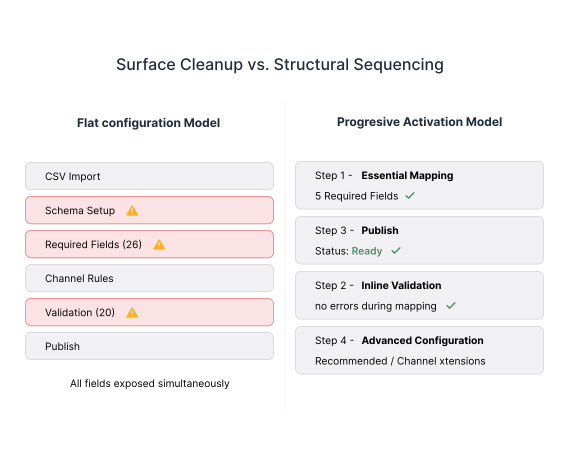
Structural Sequencing
Complexity Fails When Sequenced Poorly
Early iterations focused on cleaning the interface, reducing visual noise, and highlighting required fields. While the UI looked simpler, the underlying decision density remained unchanged. The mistake was assuming clarity comes from aesthetics. The correction came from restructuring the workflow itself, not just refining its surface.
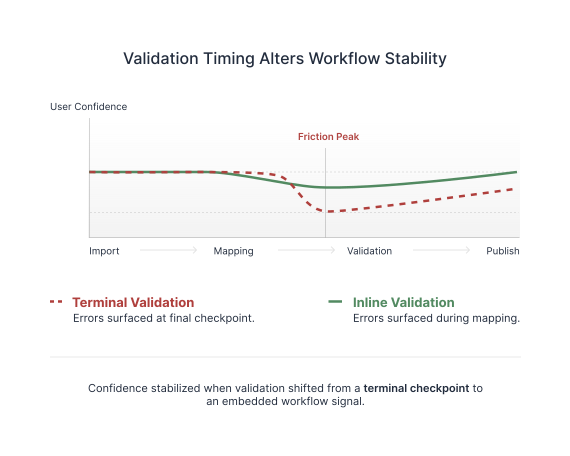
Feedback Timing
Delayed Validation Was Amplifying Friction
Initially, validation was treated as a final checkpoint. This created repetitive correction loops and eroded user confidence late in the flow. The breakthrough was recognizing that feedback timing matters as much as feedback quality. Surfacing errors inline transformed validation from punishment into guidance.
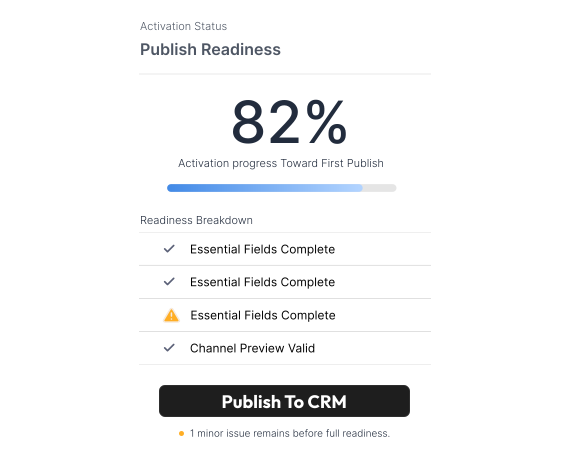
Behavioral Signals
Confidence Is Built Through Visibility, Not Completion
The original flow measured completion only at publish. But users form confidence progressively. By introducing real-time readiness visibility, the system shifted from binary success/failure to incremental progress. This reframed activation from a technical milestone into a psychological one.
If Implemented: Validation & Expansion Plan
Identify Activation Bottlenecks
Map where users drop off between configuration and first publish.
Audit onboarding funnels to identify validation loops, schema confusion, and decision-heavy steps. Establish a baseline for completion rate, time-to-first-publish, and support dependency.